
 Beds
Beds
 Accessories

Choosing a new premium mattress can feel like a high-stakes decision. With confusing labels like ‘soft’, ‘medium-firm’, and ‘orthopaedic’, it’s no wonder you might feel lost, worrying about making an expensive mistake-especially if you suffer from back pain or your partner has completely different preferences. At Bennetts Bedrooms, we believe this crucial choice shouldn’t be a source of stress. As your dedicated sleep specialists, we know that learning how to choose mattress firmness is the most important step towards unlocking years of blissful, restorative sleep and truly sleeping like royalty.
This is your definitive guide to ending the confusion for good. We will demystify the firmness scale and translate what it means for your unique body type, sleeping style, and specific comfort needs. Forget the guesswork and the fear of a costly error. By the end of this article, you will feel empowered to select the perfect handmade mattress with total confidence, ensuring you finally achieve the luxurious, pain-free rest you deserve. It’s time to stop dreaming about better sleep and start experiencing it.
Key Takeaways
- Discover why your primary sleeping position is the single most important factor for maintaining healthy spinal alignment and achieving restorative sleep.
- Learn how your body weight dramatically alters the feel of a mattress, turning a ‘firm’ choice for one person into a ‘soft’ one for another.
- Master how to choose mattress firmness by using the industry 1-10 scale to move beyond vague labels and find your precise comfort level.
- Find specialist solutions for couples with different needs, ensuring both partners can enjoy a night of uninterrupted, premium comfort.
Decoding Mattress Firmness: More Than Just ‘Soft’ or ‘Hard’
Embarking on the journey to find your perfect mattress begins with understanding one key concept: firmness. This isn’t just about whether a bed feels ‘soft’ or ‘hard’, but rather the immediate sensation of comfort and pressure relief you experience when you first lie down. It’s the initial ‘hug’ the mattress gives you. Knowing how to choose mattress firmness correctly is the first step toward unlocking a truly restorative, peaceful night’s sleep.
A truly restorative night’s sleep is the goal, whether you’re at home or traveling. In fact, many people realize the importance of a high-quality mattress after experiencing exceptional comfort at a well-appointed hotel. To get an idea of the kind of restful experience top hotels aim to provide for their guests, you can learn more.
To help illustrate this vital concept, our sleep specialists have selected this helpful video:
The Mattress Firmness Scale Explained (1-10)
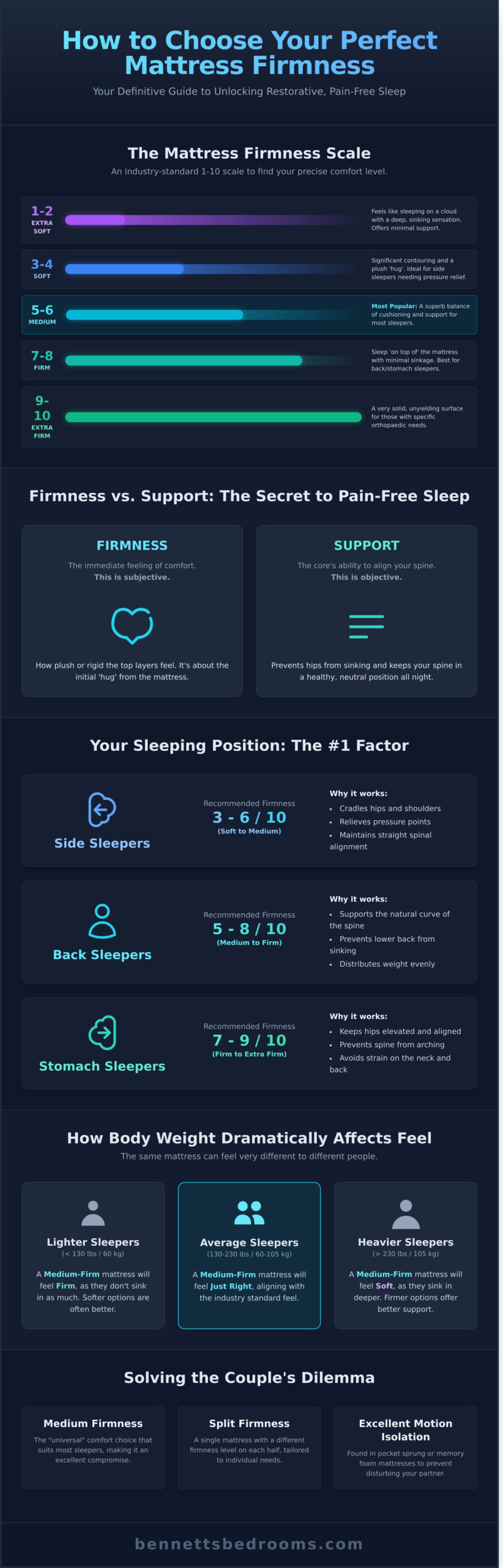
To provide a clear standard, the bedding industry uses a 1-10 scale. While every brand may have slight variations, this guide offers a reliable reference for what you can expect from our premium, handmade collections:
- 1-2 (Extra Soft): An exceptionally deep, sinking sensation. Feels like sleeping on a cloud, but with minimal underlying support.
- 3-4 (Soft): Offers significant contouring and a plush ‘hug’. Ideal for lightweight individuals and dedicated side sleepers who need maximum pressure relief on their hips and shoulders.
- 5-6 (Medium): The most popular choice for a reason. This range provides a superb balance of gentle cushioning and robust support, suiting a wide variety of sleepers.
- 7-8 (Firm): You’ll feel as though you are sleeping ‘on top of’ the mattress, with minimal sinkage. This is often preferred by back and stomach sleepers who require a more rigid surface.
- 9-10 (Extra Firm): A very solid, unyielding surface. This level of firmness is typically reserved for those with specific orthopaedic recommendations or personal preferences for maximum rigidity.
Firmness vs. Support: The Secret to Pain-Free Sleep
Here lies the most critical distinction in your search. Firmness is about comfort-a subjective feeling of plushness or rigidity from the mattress’s top layers. Support, however, is objective. It’s the essential job of the mattress’s core to keep your spine in a healthy, neutral alignment all night long. A truly luxurious mattress can be soft and supportive, while a poorly constructed one can feel firm yet fail to prevent your hips from sinking. Understanding this difference is the core of decoding mattress firmness; a premium mattress excels by pairing your preferred comfort feel with a robust, underlying support system. Lack of proper support, regardless of the firmness level, is what leads to morning aches and pains.
Why a 5-Minute Store Test Can Be Misleading
The ‘showroom feel’ can be deceptive. When you first lie on a mattress, your muscles are still tense. It takes time for your body to relax into its natural sleeping posture. To truly understand how to choose mattress firmness, we always advise our clients to lie down for at least 10-15 minutes in the position they sleep in most often. Pay close attention not just to the initial comfort, but to how your spine feels. Is it straight? Are there any pressure points or gaps? This patient approach ensures you choose a bed for a decade of quality sleep, not just for a few minutes of comfort in a store.
Your Sleeping Position: The #1 Factor for Spinal Alignment
While factors like body weight and personal preference play a role, the most critical element in how to choose mattress firmness is your dominant sleeping position. The goal is to achieve a perfectly neutral spinal alignment, where your spine maintains its natural, straight line from your neck to your tailbone. As confirmed by extensive research, Your Sleeping Position dictates where your body exerts the most pressure and, therefore, where you need cushioning and support. A mismatched firmness level can lead to painful pressure points, chronic back pain, and a restless night’s sleep. On our 1-10 firmness scale (where 1 is the softest and 10 is the firmest), here is what our sleep specialists recommend.
For Side Sleepers: Cradling Hips and Shoulders
Side sleeping concentrates your body weight onto the sharpest points-your hips and shoulders. To prevent joint pain and numbness in your arms, you need a mattress that contours to these curves. We recommend a Soft to Medium (3-6/10) firmness. This allows your hips and shoulders to sink in just enough to relieve pressure, ensuring your spine remains perfectly straight. A mattress that is too firm will push against these points, causing misalignment and discomfort.
For Back Sleepers: Supporting the Lumbar Curve
For those who sleep on their back, the primary challenge is supporting the natural ‘S’ curve of the spine, particularly the lower back (lumbar region). A mattress that is too soft will cause the hips to sink lower than the shoulders, creating a hammock effect that strains the spine. The ideal choice is a Medium to Firm (5-8/10) mattress. This provides robust support to keep your hips elevated while offering just enough cushioning to feel comfortable and supported.
For Stomach Sleepers: Preventing Pelvic Sinkage
Sleeping on your stomach places the most strain on your spine, making the right mattress crucial for preventing long-term back pain. The greatest risk is your pelvis sinking into the mattress, forcing your spine into an unnatural arch. To counteract this, a Medium-Firm to Firm (6-8/10) mattress is essential. This firm surface ensures your hips stay elevated and aligned with your shoulders, promoting a much healthier, flatter spinal position throughout the night.
How Your Body Weight Dramatically Affects Mattress Feel
One of the most significant secrets to finding your perfect mattress is understanding that firmness isn’t a fixed number-it’s a feeling, entirely relative to you. This is arguably the most overlooked factor when people learn how to choose mattress firmness. A premium mattress rated ‘medium’ will feel substantially softer and less supportive to a 100kg person than it does to a 60kg person. Matching firmness to your body weight is the foundation of achieving truly restorative sleep.
By aligning these two factors, you ensure your spine is correctly supported, pressure points are relieved, and you can finally experience the luxury comfort you deserve.
For Lighter Sleepers (Under 65kg)
Lighter individuals require a surface that responds to less pressure. A mattress that is too firm will feel unyielding, failing to contour to your body and creating uncomfortable pressure points at the shoulders and hips. For optimal comfort and alignment, we recommend a Soft to Medium feel (3-5/10). This allows for gentle cradling and ensures your spine remains perfectly straight for a peaceful night’s sleep.
For Average Weight Sleepers (65kg – 100kg)
If you fall into this weight range, most industry-standard firmness ratings are designed with you in mind. Your primary consideration then becomes your preferred sleeping position, a topic covered extensively in Wirecutter’s guide to choosing a mattress. A Medium firmness (5-7/10) is often the sweet spot, providing a harmonious balance of plush comfort and robust spinal support.
For Heavier Sleepers (Over 100kg)
For heavier individuals, exceptional support is paramount to prevent the “hammock effect,” where the midsection sinks too deeply into the mattress. A soft mattress will almost certainly lead to poor alignment and potential back pain. We advise a Medium-Firm to Firm mattress (6-8/10). It’s also crucial to choose a bed built with high-quality, durable materials engineered to resist sagging and provide lasting performance.
Ultimately, understanding how your weight interacts with a mattress is the key to unlocking years of uncompromising support. If you need personalised guidance, our Sleep Specialists are experts at matching you with a premium mattress that perfectly suits your body type and preferences.
Solving the Couple’s Dilemma: Finding a Mattress for Two
Sharing a bed is a cornerstone of any relationship, but when partners have different sleep preferences, body weights, or sleeping positions, the mattress can become a battleground. One person’s perfect firm support might feel like a rock to the other, leading to restless nights and disrupted sleep for both. This is a common challenge, but achieving harmonious, restorative sleep together is entirely possible. While compromise is one path, premium, specialized solutions ensure neither partner has to settle.
Understanding how to choose mattress firmness as a couple means looking beyond a single comfort level and considering the dynamics of two sleepers. The goal is to find a surface that provides individualised comfort and, crucially, minimises disturbances.
Finding the Middle Ground: The Medium-Firm Compromise
For many couples, a high-quality medium-firm mattress (often rated a 6-7 out of 10) offers the perfect compromise. This versatile firmness level provides robust support for back and stomach sleepers without creating uncomfortable pressure points for those who sleep on their side. It’s a beautifully balanced solution that accommodates a wide range of needs, creating a comfortable foundation for a peaceful night’s sleep together.
Motion Isolation: Your Key to Undisturbed Sleep
Beyond firmness, motion isolation is perhaps the most critical feature for a couple’s mattress. This technology absorbs movement, preventing your partner’s tossing and turning from transferring to your side of the bed. Mattresses engineered with individual pocket springs or high-density memory foam excel at this, ensuring you remain undisturbed. When considering how to choose mattress firmness, don’t overlook the profound impact that superior motion isolation will have on your shared sleep quality.
The Ultimate Solution: Zip & Link Beds
For partners with significantly different requirements, the ultimate answer is a Zip & Link bed. This innovative system combines two separate, smaller mattresses into one seamless super king or king-size bed. Each mattress can have a completely different firmness level, allowing for total personalisation. One partner can enjoy a soft, contouring surface while the other rests on a firm, supportive one. There is simply no better way to ensure both of you experience your perfect sleep, every single night. To explore this bespoke solution, ask our specialists about Zip & Link options.
Find Your Perfect Firmness and Sleep Like Royalty
Choosing the right mattress firmness isn’t about simply picking ‘soft’ or ‘hard’; it’s about finding the perfect, personalised support for your body. As we’ve discussed, your sleeping position is the most critical factor for spinal alignment, while your body weight dramatically influences how a mattress feels to you. Mastering how to choose mattress firmness is the first step toward transforming your sleep from restless to restorative.
You don’t have to make this important decision alone. As Sleep Specialists with deep expertise in both the UK and Portugal, we are here to provide expert guidance. Our curated collection features only the finest luxury handmade brands, like Relyon and Britannia, all of which are NBF ‘Big Tick’ approved for guaranteed quality and safety. We believe everyone deserves a majestic rest.
Ready to sleep like royalty? Explore our premium mattresses and find your perfect firmness. A truly peaceful night’s sleep is finally within your reach.
Frequently Asked Questions
What is the most popular mattress firmness and why?
Medium-firm is consistently the most popular choice among our clients. It offers a superb balance of supportive push-back and comfortable contouring, making it an ideal solution for a wide variety of sleeping positions and body types. This universal appeal is particularly beneficial for couples with different preferences. It delivers the essential support for spinal alignment without feeling excessively hard, ensuring a luxurious and restful night’s sleep for the majority of individuals seeking premium comfort.
Can a mattress be too firm? What are the signs to look out for?
Yes, a mattress can absolutely be too firm for your body. Key signs include waking with numbness or a “pins and needles” sensation in your arms and legs. You might also experience persistent aches in your shoulders, hips, or lower back, as the mattress isn’t allowing these pressure points to sink in properly. If you feel like you’re sleeping ‘on top’ of the bed rather than ‘in’ it, your mattress is likely providing improper support and comfort.
How long does it take to get used to a new mattress firmness?
Adjusting to a new, high-quality mattress typically takes between 30 and 90 days. This period allows your body to adapt to the new level of support and for the premium materials within the mattress to settle and soften slightly. Initially, it may feel quite different from your old bed, but patience is key. This break-in period is crucial for both you and your new mattress to achieve the optimal comfort required for a peaceful night’s sleep.
Does adding a mattress topper change the firmness of my bed?
A mattress topper primarily adjusts the comfort layer, or the initial ‘feel,’ of your bed, rather than changing its core firmness and support. For instance, a plush memory foam topper can make a firm mattress feel softer and more pressure-relieving on the surface. However, it cannot make a soft, unsupportive mattress firmer. Think of it as a luxury enhancement for comfort, not a solution for incorrect underlying support from the mattress itself.
I have chronic back pain. What is the best mattress firmness for me?
For chronic back pain, our sleep specialists often recommend a medium-firm mattress. This level of support prevents your hips from sinking too deeply, which maintains proper spinal alignment, while still being soft enough to cushion your body’s curves. When considering how to choose mattress firmness for pain relief, this balance is crucial. However, we always advise consulting with a medical professional to find the perfect solution for your specific condition and achieve truly restorative sleep.
Should my mattress firmness change as I get older?
Yes, your ideal mattress firmness can certainly change with age. As we get older, we may experience more joint pain or conditions like arthritis, making pressure relief a higher priority. Many find a slightly softer, more contouring mattress-such as a medium or medium-soft-more comfortable as it cradles the body and alleviates pressure on sensitive areas. Re-evaluating your needs ensures your bed continues to provide the royal comfort you deserve through every stage of life.
